Click Here for a Virtual Walkthrough
.png)
You’ll find our blog to be a wealth of information, covering everything from local market statistics and home values to community happenings. That’s because we care about the community and want to help you find your place in it. Please reach out if you have any questions at all. We’d love to talk with you!
You’ve worked hard. You’ve raised families, built careers, survived questionable fashion trends, and probably accumulated enough stuff to qualify for your own episode of Hoarders: The “But I Might Need That Someday” Edition.
Now you’re thinking about your next home.
Maybe you want less maintenance. Maybe you want a one-story home. Maybe you want a beautiful backyard without spending your Saturday fighting weeds. Maybe the kids have finally moved out and you’re wondering why you still have four bedrooms.
Or maybe you’re simply thinking:
“I want my next home to fit the life I actually live now.”
That is exactly where being a 55+ home shopper in Arizona can get interesting.
Whether you're looking for a home in Avondale, Goodyear, Tolleson, or somewhere else in the West Valley or Phoenix metro, there are opportunities, considerations, and potential benefits worth understanding before you make your next move.
And no, this article is not going to tell you that you need to “downsize.”
Maybe you do.
Maybe you don't.
Maybe you just need a home with fewer stairs and a garage big enough for your golf cart, hobbies, tools, and the things your adult children somehow keep leaving at your house. 😄
Let’s talk about what really matters.
One of the biggest misconceptions about buying a home after 55 is that everyone wants the same thing.
They don't.
Some buyers want a 55+ active-adult community with pools, pickleball, fitness centers, clubs, and organized activities.
Others want a traditional neighborhood where they can stay close to children and grandchildren.
Some want to downsize.
Others want to upsize their lifestyle.
And some people simply want a beautiful single-story home with a manageable yard and a kitchen where everyone can gather for Sunday dinner.
The point?
Your age doesn't determine what kind of home you should buy. Your lifestyle does.
Arizona has long attracted people looking for sunshine, outdoor recreation, newer communities, and a different pace of life.
And while we love our Arizona sunshine, let's be honest:
August has a personality. ☀️😂
Still, there are plenty of reasons 55+ buyers continue to consider the Phoenix metro and West Valley.
For buyers coming from California, Washington, Oregon, Illinois, Colorado, and other states, Arizona can also offer a very different housing environment.
But here's something important:
Don't choose Arizona simply because someone told you it's cheaper or sunnier.
Choose the community that fits your life.
One of the biggest advantages for 55+ buyers is the variety of homes available.
You might be looking for:
No stairs to navigate every time you forget why you walked upstairs in the first place.
Less time mowing, trimming, cleaning and maintaining means more time for travel, family, hobbies, or simply enjoying your morning coffee.
New construction can offer modern floor plans, energy-efficient features, updated kitchens and bathrooms, and fewer immediate renovation projects.
These communities may offer amenities such as:
And yes, pickleball deserves its own category at this point.
It has apparently conquered America one paddle at a time. 🏓
For many 55+ buyers, this isn't their first rodeo.
You've potentially built equity over many years.
That can create opportunities that weren't available when you purchased your first home.
Depending on your individual financial situation, you may have:
This is where having a conversation with a qualified lender and your real estate professional can be extremely valuable.
Important: Home equity is not automatically the same thing as available cash, and every buyer's financial situation is different. Your lender, financial advisor, and tax professional can help you understand your individual options.
When you're buying your first house, you might be thinking:
"Can I afford this?"
Later in life, the question can become:
"Does this home actually work for me?"
That's a powerful shift.
You can prioritize things like:
This is not necessarily downsizing.
It's rightsizing.
You're choosing a home based on how you want to live.
Here's where things get particularly interesting for buyers considering the Phoenix metro.
The West Valley has experienced significant residential, commercial, and infrastructure growth.
Cities such as Avondale, Goodyear, and Tolleson offer a range of housing styles and price points, along with access to major employment centers, shopping, restaurants, recreation, and transportation routes.
And the West Valley isn't standing still.
New restaurants, retail centers, entertainment destinations, and mixed-use developments continue to reshape communities.
That matters because you're not just buying four walls.
You're buying into a community.
Avondale can be attractive for buyers who want access to the larger Phoenix metro while remaining in the West Valley.
The area offers established neighborhoods, newer developments, shopping, restaurants, recreation, and access to major transportation corridors.
For a 55+ buyer, that can mean having plenty of conveniences without necessarily feeling like you're living in the middle of a concrete jungle.
Goodyear has become one of the West Valley's most talked-about growth areas.
From newer communities to golf, recreation, restaurants, retail, and major developments such as GSQ, the city continues to evolve.
For 55+ buyers, Goodyear can offer an appealing combination of:
And let's be honest, having a good restaurant five minutes away is a very respectable retirement strategy.
Tolleson is another community worth considering for buyers who want West Valley convenience.
Its location provides access to major freeways and nearby communities while offering residential neighborhoods and local amenities.
For buyers relocating to Arizona, comparing communities like Tolleson, Avondale, and Goodyear can help you determine which location best fits your budget and lifestyle.
One of the biggest mistakes buyers make is focusing only on the property.
Instead, ask:
"What will my everyday life look like here?"
Imagine a normal Tuesday.
Where will you get coffee?
How far is the grocery store?
Where will you exercise?
How long will it take to see your grandchildren?
Are restaurants nearby?
Is there a community center?
What about golf?
Pickleball?
Walking trails?
Healthcare?
Airport access?
These details become incredibly important because you're not buying a house for one Saturday afternoon.
You're buying your everyday life.
When you're younger, a bigger house can feel like the ultimate goal.
At 55+, many buyers begin thinking differently.
Would you rather have:
2,800 square feet and a huge maintenance list?
Or:
2,000 square feet, a great floor plan, and more time to travel?
There isn't a right answer.
But it's worth asking.
Especially if your goal is to spend more time doing the things you enjoy rather than maintaining rooms nobody uses.
If you're moving from another state, don't make the mistake of buying based solely on internet photos.
Arizona communities can look surprisingly different from one another.
A home in Goodyear can feel very different from a home in central Phoenix.
Avondale can offer a different lifestyle than Scottsdale.
Tolleson can have different conveniences than Buckeye.
And the West Valley is a big place.
Before buying, think about:
Do you want quiet or activity?
How close do you want to be to children and grandchildren?
How important is airport access?
Which medical facilities and services are convenient?
Golf? Pickleball? Hiking? Travel? Gardening? Volunteering?
Does the home work for you five, ten, or fifteen years from now?
That last question is especially important.
Buying at 55 or older isn't necessarily more complicated.
It is simply different.
You may have more financial experience, but you may also have more moving pieces.
For example, you may be:
That's why assembling the right team matters.
A real estate professional can help you understand the property and transaction.
A lender can explain financing options.
A financial advisor can help evaluate the larger financial picture.
A tax professional can advise on tax-specific questions.
Nobody expects you to be an expert in all of it.
That's what the team is for.
Not necessarily.
Age classifications vary depending on the context and community. Some active-adult communities have specific age requirements, often based on federal housing rules and community policies.
Always verify the specific requirements of the community you're considering.
Yes. Arizona has numerous active-adult and age-qualified communities throughout the Phoenix metro and other parts of the state.
The amenities, fees, restrictions, and age requirements can vary significantly, so it's important to compare communities carefully.
You don't have to.
But many buyers appreciate single-level living because it can provide convenience now and potentially make the home easier to navigate later.
Think of it as giving your future self a little favor.
Future You will appreciate it.
Not automatically.
Consider rightsizing instead.
The goal isn't necessarily to have fewer square feet. It's to have the right amount of space for the way you actually live.
Yes. Retirement itself does not prevent someone from purchasing a home.
Mortgage qualification depends on factors such as income, assets, credit, debt, down payment, and the lender's requirements.
A qualified mortgage professional can explain what income and assets may be considered for your specific situation.
There isn't one universal answer.
For West Valley buyers, communities such as Avondale, Goodyear, and Tolleson can be worth exploring, depending on your budget, lifestyle, desired amenities, family location, and commute or travel needs.
The "best" city is the one that makes your everyday life easier and happier.
Arizona does have certain property-tax programs and exemptions, but eligibility depends on the specific program and individual circumstances.
Because tax rules can change, homeowners should verify current requirements with the appropriate Arizona government agency or a qualified tax professional.
Don't rely on something your neighbor's cousin's barber heard at breakfast. 😂
If you've been searching questions like these, you're definitely not alone:
"Where should I retire in Arizona?"
"What are the best 55+ communities in the Phoenix area?"
"Should I buy a single-story home after 55?"
"Is Goodyear Arizona a good place to retire?"
"Is Avondale Arizona a good place for retirees?"
"What should I look for when buying a home after 55?"
"Should I downsize or rightsize my home?"
"Can retired people qualify for a mortgage in Arizona?"
"What should I know before relocating to Arizona after 55?"
These are exactly the kinds of questions worth asking before you start touring homes.
At Rosie & Mariela Armenta, we believe buying or selling a home should be about more than square footage, countertops, and whether the backyard has enough room for the grandkids.
It's about people.
It's about listening to what you want.
It's about understanding where you are in life and where you want to go next.
And that's actually why we started in real estate.
We wanted to make sure people had a real estate agent who genuinely cared and who saw every client as family.
Whether you're buying your first Arizona home, relocating to the West Valley, moving closer to family, looking for an active-adult community, or simply searching for a home that better fits this chapter of your life, you deserve someone in your corner.
Someone who will answer the questions you haven't thought to ask yet.
Someone who will tell you when a house looks beautiful online but doesn't make sense for your lifestyle.
Someone who will celebrate with you when you get the keys.
Because at the end of the day, real estate is about homes, but it's really about people.
And that's how we believe it should be. ❤️
Rosie & Mariela Armenta
West USA Realty
📞 623-295-5770
✉️ rosie@rosiearmenta.com
🏠 Equal Housing Opportunity
 Comprar una Casa en el West Valley: Guía para Compradores sobre Buckeye, Goodyear, Surprise y Más
Si estás pensando en comprar una casa en el West Valley, tienes más opciones que nunca.
Desde vecindarios establecidos en Avondale y Tolleson hasta comunidades más nuevas en Buckeye y Surprise, el West Valley ofrece una amplia variedad de casas, estilos de vida, precios y tipos de propiedad. Y para los compradores que buscan más espacio, terrenos amplios o incluso terrenos sin construir, existen oportunidades que quizá no encuentres en otras partes del área metropolitana de Phoenix.
Pero tener más opciones también implica saber qué buscar.
Ya seas un comprador de vivienda por primera vez, estés mudándote a Arizona, comprando tu próxima casa, buscando una propiedad de inversión o buscando terreno, esta guía te ayudará a entender qué debes considerar antes de realizar una compra.
Antes de comenzar a programar visitas, es útil entender exactamente qué estás buscando.
Nuestra búsqueda de propiedades te permite explorar propiedades en todo el West Valley y reducir tus opciones según precio, ubicación, tipo de propiedad, recámaras, baños, tamaño del terreno y otras características.
[Buscar casas y terrenos en el West Valley →]
Si no estás seguro de qué área es la adecuada para ti, no te preocupes. Ahí es donde la orientación de un agente local puede marcar una gran diferencia.
El West Valley se ha convertido en una parte importante del mercado inmobiliario del área metropolitana de Phoenix, con comunidades como Buckeye, Goodyear, Surprise, Avondale y Litchfield Park que ofrecen diferentes combinaciones de precio, ubicación, servicios, tamaños de terreno y construcciones nuevas.
Una de las mayores ventajas es simplemente la variedad.
Puedes encontrar:
Esta variedad significa que dos compradores con el mismo presupuesto podrían tener opciones completamente diferentes dependiendo de dónde decidan buscar.
No existe una sola ciudad del West Valley que sea la “mejor” para todos los compradores.
La ubicación adecuada depende de tu presupuesto, tiempo de traslado, estilo de vida, tamaño de casa que deseas, tamaño del terreno, escuelas, servicios y planes a largo plazo.
Estas son algunas de las áreas que ayudamos a los compradores a explorar.
Buckeye es una de las áreas más extensas del West Valley y puede ser especialmente interesante para compradores que buscan construcciones nuevas, propiedades más grandes y terrenos.
Debido a la cantidad de desarrollo y espacio disponible, los compradores deben pensar más allá de la casa en sí.
Considera:
Si estás considerando comprar terreno o una propiedad con mucha extensión, estas preguntas se vuelven aún más importantes.
[Buscar casas en venta en Buckeye →]
Goodyear ofrece una combinación de vecindarios establecidos, nuevos desarrollos, comunidades planificadas y propiedades de mayor nivel.
Los compradores pueden encontrar desde casas más pequeñas para compradores primerizos hasta casas más grandes en comunidades con numerosos servicios y amenidades.
La ubicación dentro de Goodyear es importante, así que no asumas que todas las propiedades ofrecen el mismo estilo de vida o tiempo de traslado.
[Buscar casas en venta en Goodyear →]
Surprise se ha convertido en una opción popular para compradores que buscan una combinación de comunidades residenciales, servicios, casas nuevas y acceso al resto del West Valley.
También existe una diferencia considerable entre las distintas partes de la ciudad.
Al comparar propiedades, presta atención a los tiempos de traslado, servicios del vecindario, cuotas de HOA, tamaños de los terrenos y proximidad a los lugares que son más importantes para ti.
[Buscar casas en venta en Surprise →]
Avondale puede ser atractiva para compradores que desean permanecer relativamente cerca del centro de Phoenix mientras mantienen acceso a las comunidades y servicios del West Valley.
La ciudad ofrece una variedad de vecindarios establecidos y nuevos, por lo que vale la pena comparar las propiedades considerando tanto el precio como la ubicación.
[Buscar casas en venta en Avondale →]
Litchfield Park es conocida por sus vecindarios establecidos, paisajes maduros, servicios recreativos y ambiente orientado hacia la comunidad.
Para los compradores que priorizan el carácter del vecindario y el estilo de vida, puede valer la pena comparar Litchfield Park con Goodyear y otras comunidades cercanas del West Valley.
[Buscar casas en venta en Litchfield Park →]
El Mirage puede ofrecer a los compradores otra opción al comparar viviendas en el West Valley según precio, ubicación y características de la propiedad.
Si estás buscando en varias ciudades, no descartes propiedades simplemente porque están fuera de tu área inicial de búsqueda. Un pequeño cambio de ubicación puede marcar una diferencia significativa en lo que tu presupuesto puede comprar.
[Buscar casas en venta en El Mirage →]
Waddell puede ser especialmente interesante para compradores que desean más espacio y una sensación diferente a la de un vecindario suburbano tradicional.
Las propiedades en esta área pueden variar considerablemente en tamaño de terreno y uso, por lo que los compradores deben investigar cuidadosamente la propiedad en sí y no depender únicamente de la descripción del anuncio.
[Buscar casas y terrenos en Waddell →]
Tolleson ofrece otra opción para compradores que desean acceso al West Valley mientras permanecen relativamente cerca de importantes corredores de empleo y transporte.
Como ocurre con cualquier ubicación, compara la propiedad individual, el vecindario, la HOA, los impuestos y el tiempo de traslado en lugar de tomar una decisión basándote únicamente en el nombre de la ciudad.
[Buscar casas en venta en Tolleson →]
Uno de los errores más grandes que cometen los compradores es fijarse únicamente en el precio de compra.
Tu gasto mensual real de vivienda puede incluir:
En el condado de Maricopa, los impuestos sobre la propiedad se basan en valores tasados y tasas impositivas establecidas por múltiples jurisdicciones tributarias, no simplemente por el condado.
Por eso, dos casas con precios de compra similares pueden tener costos mensuales diferentes.
Antes de enamorarte de una propiedad, habla con tu prestamista sobre un pago mensual que se ajuste cómodamente a tu presupuesto.
Después, utiliza tu búsqueda de propiedades para ver casas dentro de ese rango, en lugar de buscar simplemente el monto máximo que podrías calificar para pedir prestado.
En Arizona, la propiedad en sí puede ser tan importante como la casa.
Cuando visites casas, presta atención a:
Y si estás comprando una propiedad con mucho terreno, la lista se vuelve aún más importante.
Los compradores de terrenos necesitan realizar un nivel diferente de investigación y diligencia que el de alguien que compra una casa suburbana típica.
Un hermoso terreno vacío no necesariamente es un buen lugar para construir.
Antes de comprar un terreno, investiga aspectos como:
¿De dónde provendrá el agua?
Dependiendo de la ubicación y la propiedad, es posible que necesites entender el servicio de agua municipal, un pozo privado, derechos de agua u otras consideraciones relacionadas con el suministro de agua.
El Arizona Department of Real Estate recomienda específicamente que los posibles compradores investiguen la disponibilidad de agua antes de comprar una propiedad y dirige a los compradores al Arizona Department of Water Resources para obtener información sobre aguas subterráneas y suministros de agua.
Las reglas relacionadas con el suministro de agua en Arizona también pueden variar dependiendo de si una propiedad se encuentra dentro o fuera de un Área de Manejo Activo (Active Management Area).
Si la propiedad no está conectada a un sistema de alcantarillado municipal, querrás entender cómo se manejarán las aguas residuales.
Esto puede implicar investigar la viabilidad de un sistema séptico, sistemas existentes, inspecciones y el costo de instalar o reemplazar un sistema.
No asumas que, porque puedes ver un terreno en un mapa, automáticamente tienes el acceso que necesitas.
Verifica el acceso legal y físico a la propiedad.
Averigua cómo recibirá la propiedad:
El costo de llevar servicios públicos a un terreno sin construir puede afectar significativamente el costo real de tu proyecto.
Antes de comprar un terreno, determina qué puedes hacer legalmente con él.
El uso que tienes pensado podría incluir:
La respuesta puede depender de la zonificación, el tamaño del terreno, las regulaciones de la ciudad o el condado, las restricciones de la escritura y otros factores.
El Arizona Department of Real Estate recomienda específicamente que los compradores investiguen aspectos como agua, servicios públicos, eliminación de aguas residuales, acceso y otras consideraciones de la propiedad al comprar terrenos.
Si estás buscando terrenos en Arizona, no busques solamente por precio. Busca según lo que quieres lograr con la propiedad.
[Buscar terrenos en venta en el West Valley →]
Los compradores del West Valley a menudo tienen la oportunidad de comparar casas de reventa con construcciones nuevas.
Ambas opciones pueden tener sentido.
Entre las posibles ventajas se encuentran:
Pero los compradores también deben considerar:
Una casa de reventa puede ofrecer:
La mejor opción depende de tus prioridades.
Y no asumas que el incentivo anunciado por el constructor automáticamente convierte una casa nueva en la mejor decisión financiera. Compara el costo total de compra y el pago mensual con propiedades de reventa comparables.
Las casas en Arizona tienen algunas consideraciones particulares.
Dependiendo de la propiedad, tu inspección y proceso de diligencia debida pueden incluir una revisión detallada de:
Para las propiedades con sistemas sépticos u otros sistemas alternativos de tratamiento de aguas residuales en el sitio, Arizona cuenta con requisitos específicos de inspección y transferencia.
Una inspección de la casa no se trata de encontrar una casa “perfecta”. Se trata de comprender la condición de la propiedad para que puedas tomar una decisión informada.
Una de las cosas más importantes que les digo a los compradores es que evalúen toda la propiedad y su ubicación, no solamente las fotografías.
Antes de hacer una oferta, considera:
La casa:
¿La distribución funciona para ti?
El vecindario:
¿La comunidad se adapta a tu estilo de vida?
La ubicación:
¿Cuánto tiempo realmente te tomará llegar al trabajo?
El futuro:
¿Qué desarrollos están planeados cerca?
Los costos:
¿Cuál será tu gasto total mensual de vivienda?
La propiedad:
¿Existen problemas relacionados con agua, drenaje, servicios públicos, restricciones de la HOA u otros factores?
El potencial de reventa:
Si tus planes cambian, ¿la propiedad será atractiva para otros compradores?
Esto es especialmente importante en un área de rápido crecimiento, donde los terrenos vacantes o espacios abiertos que existen hoy podrían no permanecer así para siempre.
No necesitas saber exactamente qué ciudad del West Valley quieres antes de comenzar.
De hecho, comparar varias áreas puede ayudarte a descubrir dónde funciona mejor tu presupuesto.
Ayudamos a compradores a buscar en:
Buckeye • Goodyear • Surprise • Avondale • Litchfield Park • El Mirage • Waddell • Tolleson • Tonopah y todo el West Valley
Trabajamos con todo tipo de compradores, incluyendo compradores primerizos, compradores que buscan una casa más grande, inversionistas, compradores que se están reubicando, compradores de propiedades de lujo y clientes que buscan terrenos vacantes y propiedades con grandes extensiones de terreno.
Explora las propiedades disponibles y descubre qué hay actualmente en el mercado.
[Buscar casas y terrenos en el West Valley →]
Si encuentras una propiedad que te interesa, podemos ayudarte a evaluar la oportunidad, entender la propiedad y determinar qué preguntas deben responderse antes de hacer una oferta.
La casa adecuada no se trata solamente de encontrar una casa que te encante.
Se trata de encontrar la propiedad adecuada, en la ubicación correcta, al precio correcto y de acuerdo con tus objetivos.
La información inmobiliaria, las condiciones del mercado, la disponibilidad, los impuestos, la zonificación, la disponibilidad de agua y otras características de las propiedades pueden cambiar. Los compradores deben verificar de manera independiente la información y consultar con los profesionales correspondientes sobre asuntos legales, financieros, fiscales, de agua, zonificación, inspección y otras cuestiones específicas de la propiedad.

Has trabajado duro. Has criado una familia, construido una carrera, sobrevivido a modas que hoy preferirías olvidar y probablemente acumulado suficientes cosas como para tener tu propio episodio de “¿Por qué sigo guardando esto si no lo he usado en 12 años?” 😂
Ahora estás pensando en tu próximo hogar.
Tal vez quieres menos mantenimiento. Tal vez buscas una casa de una sola planta. Quizás quieres un patio bonito sin pasar todos los sábados peleando con las malas hierbas. O tal vez los hijos finalmente se fueron de casa y estás preguntándote por qué todavía tienes cuatro recámaras.
O quizá simplemente estás pensando:
“Quiero que mi próxima casa se adapte a la vida que realmente vivo ahora.”
Y precisamente ahí es donde ser un comprador de vivienda de 55 años o más en Arizona puede ponerse interesante.
Ya sea que estés buscando una casa en Avondale, Goodyear, Tolleson o en alguna otra comunidad del West Valley o del área metropolitana de Phoenix, hay oportunidades, beneficios y aspectos importantes que debes conocer antes de dar el siguiente paso.
Y no, este artículo no te va a decir que necesariamente tienes que “reducir tu casa”.
Tal vez sí.
Tal vez no.
Tal vez simplemente necesitas una casa de una sola planta con menos escaleras y un garaje lo suficientemente grande para tu carrito de golf, tus herramientas, tus hobbies y todas esas cosas que tus hijos adultos siguen dejando en tu casa. 😄
Hablemos de lo que realmente importa.
Uno de los mayores errores al hablar de compradores de 55 años o más es asumir que todos buscan el mismo estilo de vida.
No es así.
Algunos compradores quieren una comunidad para adultos activos de 55+, con piscinas, pickleball, gimnasios, clubes, actividades y eventos sociales.
Otros prefieren un vecindario tradicional donde puedan estar cerca de sus hijos y nietos.
Algunos quieren reducir el tamaño de su casa.
Otros quieren aumentar el nivel de su estilo de vida.
Y otros simplemente quieren una hermosa casa de una sola planta, con un patio fácil de mantener y una cocina donde toda la familia pueda reunirse para la cena del domingo.
¿La idea principal?
Tu edad no determina qué tipo de casa debes comprar. Tu estilo de vida sí.
Arizona ha atraído durante años a personas que buscan sol, actividades al aire libre, comunidades nuevas y un ritmo de vida diferente.
Y aunque nos encanta el sol de Arizona, seamos sinceros:
Agosto tiene personalidad propia. ☀️😂
Aun así, existen muchas razones por las que los compradores de 55+ siguen considerando el área metropolitana de Phoenix y el West Valley.
Para compradores que llegan de California, Washington, Oregón, Illinois, Colorado y otros estados, Arizona también puede ofrecer un entorno de vivienda muy diferente.
Pero aquí hay algo importante:
No elijas Arizona simplemente porque alguien te dijo que es más barato o que siempre hace sol.
Elige la comunidad que se adapte a TU vida.
Una de las mayores ventajas para los compradores de 55+ es la variedad de viviendas disponibles.
Podrías estar buscando:
Menos escaleras que subir cada vez que olvidas por qué subiste al segundo piso en primer lugar.
Menos tiempo cortando el césped, podando, limpiando y haciendo mantenimiento significa más tiempo para viajar, pasar tiempo con la familia, disfrutar de tus hobbies o simplemente tomar tu café de la mañana tranquilamente.
Las casas de nueva construcción pueden ofrecer planos modernos, características de eficiencia energética, cocinas y baños actualizados y menos proyectos de remodelación inmediatos.
Estas comunidades pueden ofrecer amenidades como:
Y sí, el pickleball merece su propia categoría a estas alturas.
Al parecer conquistó Estados Unidos con una pala a la vez. 🏓
Para muchos compradores de 55+, esta no es su primera experiencia comprando una casa.
Es posible que hayas acumulado patrimonio con el paso de los años.
Eso puede crear oportunidades que no estaban disponibles cuando compraste tu primera vivienda.
Dependiendo de tu situación financiera individual, podrías tener:
Aquí es donde puede ser muy útil hablar con un prestamista calificado y con tu profesional de bienes raíces.
Importante: El patrimonio acumulado en una vivienda no es automáticamente lo mismo que dinero disponible en efectivo, y la situación financiera de cada comprador es diferente. Tu prestamista, asesor financiero y profesional de impuestos pueden ayudarte a comprender tus opciones individuales.
Cuando compras tu primera casa, probablemente estás pensando:
"¿Puedo pagarla?"
Más adelante en la vida, la pregunta puede cambiar a:
“¿Esta casa realmente funciona para mí?”
Ese cambio es importante.
Ahora puedes darle prioridad a cosas como:
Esto no necesariamente significa reducir el tamaño de tu casa.
Significa elegir el tamaño y espacio adecuados para tu vida.
Estás escogiendo una casa basada en cómo quieres vivir.
Aquí es donde las cosas se ponen especialmente interesantes para quienes están considerando el área metropolitana de Phoenix.
El West Valley ha experimentado un importante crecimiento residencial, comercial y de infraestructura.
Ciudades como Avondale, Goodyear y Tolleson ofrecen una variedad de estilos de vivienda y rangos de precios, además de acceso a centros de empleo, tiendas, restaurantes, actividades recreativas y principales vías de transporte.
Y el West Valley no se está quedando quieto.
Nuevos restaurantes, centros comerciales, lugares de entretenimiento y desarrollos de uso mixto continúan transformando estas comunidades.
¿Por qué importa?
Porque no estás comprando solamente cuatro paredes.
Estás comprando una comunidad.
Avondale puede ser una opción atractiva para compradores que quieren acceso al área metropolitana de Phoenix mientras permanecen en el West Valley.
La ciudad ofrece vecindarios establecidos, nuevas comunidades, tiendas, restaurantes, actividades recreativas y acceso a importantes vías de transporte.
Para un comprador de 55+, esto puede significar tener muchas comodidades cerca sin necesariamente sentir que estás viviendo en medio de una jungla de concreto.
Goodyear se ha convertido en una de las comunidades de mayor crecimiento y más comentadas del West Valley.
Desde nuevas comunidades residenciales hasta golf, actividades recreativas, restaurantes, tiendas y grandes desarrollos como GSQ, la ciudad continúa evolucionando.
Para compradores de 55+, Goodyear puede ofrecer una combinación atractiva de:
Y seamos honestos: tener un buen restaurante a cinco minutos de casa es una estrategia de jubilación bastante respetable.
Tolleson es otra comunidad que vale la pena considerar para compradores que buscan conveniencia en el West Valley.
Su ubicación ofrece acceso a importantes autopistas y a comunidades cercanas, además de vecindarios residenciales y servicios locales.
Para quienes se están mudando a Arizona desde otro estado, comparar comunidades como Tolleson, Avondale y Goodyear puede ayudarles a determinar cuál se adapta mejor a su presupuesto y estilo de vida.
Uno de los errores más comunes de los compradores es enfocarse únicamente en la propiedad.
En lugar de eso, pregúntate:
“¿Cómo será mi vida cotidiana aquí?”
Imagina un martes normal.
¿Dónde vas a tomar tu café?
¿Qué tan lejos está el supermercado?
¿Dónde vas a hacer ejercicio?
¿Cuánto tardarás en visitar a tus nietos?
¿Hay restaurantes cerca?
¿Hay un centro comunitario?
¿Y el golf?
¿Pickleball?
¿Senderos para caminar?
¿Servicios médicos?
¿Acceso al aeropuerto?
Estos detalles se vuelven increíblemente importantes porque no estás comprando una casa solamente para pasar un sábado por la tarde.
Estás comprando tu vida cotidiana.
Cuando eres más joven, una casa más grande puede sentirse como el objetivo final.
Después de los 55, muchos compradores comienzan a pensar de manera diferente.
¿Qué preferirías?
¿2,800 pies cuadrados y una enorme lista de mantenimiento?
¿O?
¿2,000 pies cuadrados, un excelente plano y más tiempo para viajar?
No existe una respuesta correcta para todos.
Pero vale la pena preguntártelo.
Especialmente si tu objetivo es pasar más tiempo haciendo las cosas que disfrutas y menos tiempo manteniendo habitaciones que casi nadie utiliza.
Si te estás mudando desde otro estado, no cometas el error de comprar basándote únicamente en fotografías de internet.
Las comunidades de Arizona pueden verse sorprendentemente diferentes unas de otras.
Una casa en Goodyear puede ofrecer una experiencia muy diferente a una casa en el centro de Phoenix.
Avondale puede ofrecer un estilo de vida diferente al de Scottsdale.
Tolleson puede tener diferentes comodidades que Buckeye.
Y el West Valley es muy grande.
Antes de comprar, piensa en:
¿Quieres tranquilidad o actividad?
¿Qué tan cerca quieres estar de tus hijos y nietos?
¿Qué tan importante es estar cerca del aeropuerto?
¿Qué hospitales y servicios médicos están convenientemente ubicados?
¿Golf? ¿Pickleball? ¿Senderismo? ¿Viajes? ¿Jardinería? ¿Voluntariado?
¿La casa seguirá funcionando para ti dentro de cinco, diez o quince años?
Esta última pregunta es especialmente importante.
Comprar una casa después de los 55 no necesariamente es más complicado.
Simplemente es diferente.
Es posible que tengas más experiencia financiera, pero también podrías tener más cosas que coordinar.
Por ejemplo, podrías estar:
Por eso es importante contar con el equipo adecuado.
Un profesional de bienes raíces puede ayudarte a entender la propiedad y la transacción.
Un prestamista puede explicarte las opciones de financiamiento.
Un asesor financiero puede ayudarte a evaluar el panorama financiero completo.
Un profesional de impuestos puede orientarte sobre preguntas relacionadas específicamente con impuestos.
Nadie espera que seas experto en todo.
Para eso existe un buen equipo.
No necesariamente.
Las clasificaciones de edad pueden variar dependiendo del contexto y de la comunidad. Algunas comunidades para adultos activos tienen requisitos específicos de edad, que pueden estar relacionados con las leyes federales de vivienda y las reglas particulares de cada comunidad.
Siempre verifica los requisitos específicos de la comunidad que estés considerando.
Sí. Arizona cuenta con numerosas comunidades para adultos activos y comunidades con requisitos de edad en diferentes partes del estado, incluyendo el área metropolitana de Phoenix.
Las amenidades, cuotas, restricciones y requisitos de edad pueden variar considerablemente, por lo que es importante comparar cuidadosamente cada comunidad.
No es obligatorio.
Pero muchos compradores disfrutan de la comodidad de vivir en un solo nivel porque puede facilitar la vida cotidiana ahora y potencialmente hacer que la casa sea más fácil de recorrer en el futuro.
Piénsalo como hacerle un pequeño favor a tu futuro yo.
Tu futuro yo probablemente lo agradecerá.
No necesariamente.
Considera elegir el tamaño adecuado para tu estilo de vida.
El objetivo no necesariamente es tener menos pies cuadrados. Se trata de tener la cantidad de espacio adecuada para la manera en que realmente vives.
Sí. Estar jubilado no impide automáticamente que alguien compre una vivienda.
La aprobación de una hipoteca depende de factores como ingresos, activos, crédito, deudas, pago inicial y los requisitos específicos del prestamista.
Un profesional hipotecario calificado puede explicarte qué ingresos y activos pueden ser considerados para tu situación particular.
No existe una respuesta universal.
Para compradores interesados en el West Valley, comunidades como Avondale, Goodyear y Tolleson pueden valer la pena explorar, dependiendo de tu presupuesto, estilo de vida, amenidades que deseas, ubicación de tu familia y necesidades de transporte o viajes.
La mejor ciudad es la que hace que tu vida diaria sea más fácil y agradable.
Arizona cuenta con ciertos programas y posibles beneficios relacionados con los impuestos sobre la propiedad, pero los requisitos dependen del programa específico y de las circunstancias individuales.
Debido a que las reglas fiscales pueden cambiar, los propietarios deben verificar los requisitos actuales con la agencia gubernamental correspondiente de Arizona o con un profesional de impuestos calificado.
No te bases en lo que escuchó el primo del vecino del peluquero durante el desayuno. 😂
En Rosie & Mariela Armenta, creemos que comprar o vender una casa debe ser mucho más que hablar de pies cuadrados, encimeras y si el patio tiene suficiente espacio para los nietos.
Se trata de personas.
Se trata de escucharte.
Se trata de entender en qué etapa de tu vida estás y hacia dónde quieres ir.
Y esa es precisamente la razón por la que comenzamos en bienes raíces.
Queríamos asegurarnos de que las personas tuvieran un agente de bienes raíces que realmente se preocupara por ellas y que viera a cada cliente como parte de la familia.
Ya sea que estés comprando tu primera casa en Arizona, mudándote al West Valley, acercándote a tus hijos y nietos, buscando una comunidad para adultos activos o simplemente buscando una casa que se adapte mejor a esta nueva etapa de tu vida, mereces tener a alguien de tu lado.
Alguien que responda las preguntas que quizá todavía no sabes que necesitas hacer.
Alguien que te diga cuándo una casa se ve hermosa en internet, pero realmente no tiene sentido para tu estilo de vida.
Alguien que celebre contigo cuando recibas las llaves.
Porque al final del día, los bienes raíces se tratan de casas, pero realmente se trata de personas.
Y así es exactamente como creemos que debe ser. ❤️
Rosie & Mariela Armenta
West USA Realty
📞 623-295-5770
✉️ rosie@rosiearmenta.com
🏠 Igualdad de Oportunidad de Vivienda

If you're thinking about buying a home in the West Valley, you have more options than ever.
From established neighborhoods in Avondale and Tolleson to newer communities in Buckeye and Surprise, the West Valley offers a wide range of homes, lifestyles, price points, and property types. And for buyers who want more space, acreage, or even vacant land, there are opportunities that you may not find in other parts of the Phoenix metro area.
But having more choices also means knowing what to look for.
Whether you're a first-time home buyer, relocating to Arizona, purchasing your next home, looking for an investment property, or searching for land, this guide will help you understand what to consider before making a purchase.
Before you start scheduling showings, it helps to understand exactly what you're looking for.
Our home search lets you explore properties throughout the West Valley and narrow your options by price, location, property type, bedrooms, bathrooms, acreage, and other features.
[Search West Valley Homes & Land →]
If you're not sure which area is right for you, don't worry. That's where local guidance can make a big difference.
The West Valley has become an important part of the greater Phoenix metro housing market, with communities such as Buckeye, Goodyear, Surprise, Avondale, and Litchfield Park offering buyers different combinations of price, location, amenities, lot sizes, and new construction.
One of the biggest advantages is simply choice.
You can find:
Starter homes and first-time buyer opportunities
Larger single-family homes
New construction
Gated communities
Master-planned communities
Homes with larger lots
Horse properties and acreage
Investment opportunities
Vacant residential land
Rural and semi-rural properties
That variety means two buyers with the same budget could have completely different options depending on where they choose to look.
There isn't one "best" West Valley city for every buyer.
The right location depends on your budget, commute, lifestyle, desired home size, lot size, schools, amenities, and long-term plans.
Here are some of the areas we help buyers explore.
Buckeye is one of the most expansive areas of the West Valley and can be particularly interesting for buyers looking for newer construction, larger properties, and land.
Because of the amount of development and available space, buyers should think beyond just the house itself.
Consider:
Distance to work
Future development
Road access
Utilities
Water
HOA requirements
Lot size
Future plans for the property
If you're considering land or acreage, these questions become even more important.
[Search Homes for Sale in Buckeye →]
Goodyear offers a mix of established neighborhoods, newer developments, master-planned communities, and higher-end properties.
Buyers may find everything from smaller starter homes to larger homes in communities with extensive amenities.
Location within Goodyear matters, so don't assume every property will provide the same lifestyle or commute.
[Search Homes for Sale in Goodyear →]
Surprise has become a popular choice for buyers looking for a combination of residential communities, amenities, newer homes, and access to the broader West Valley.
There is also significant variation between different parts of the city.
When comparing properties, pay attention to commute times, neighborhood amenities, HOA fees, lot sizes, and proximity to the destinations that matter most to you.
[Search Homes for Sale in Surprise →]
Avondale can be attractive to buyers who want to remain relatively close to central Phoenix while still having access to West Valley communities and amenities.
The city offers a variety of established and newer neighborhoods, making it worthwhile to compare properties based on both price and location.
[Search Homes for Sale in Avondale →]
Litchfield Park is known for its established neighborhoods, mature landscaping, recreational amenities, and community-oriented atmosphere.
For buyers who prioritize neighborhood character and lifestyle, it can be worth comparing Litchfield Park with nearby Goodyear and other West Valley communities.
[Search Homes for Sale in Litchfield Park →]
El Mirage can offer buyers another option when comparing West Valley housing based on price, location, and property characteristics.
If you're shopping across multiple cities, don't overlook properties simply because they are outside your initial search area. A small change in location can sometimes make a meaningful difference in what your budget can buy.
[Search Homes for Sale in El Mirage →]
Waddell can be especially interesting for buyers who want more space and a different feel from a traditional suburban neighborhood.
Properties in this area can vary considerably in lot size and use, so buyers should carefully investigate the property itself rather than relying solely on the listing description.
[Search Waddell Homes & Land →]
Tolleson offers another option for buyers who want West Valley access while remaining relatively close to major employment and transportation corridors.
As with any location, compare the individual property, neighborhood, HOA, taxes, and commute rather than making a decision based solely on the city name.
[Search Homes for Sale in Tolleson →]
One of the biggest mistakes buyers make is looking only at the purchase price.
Your actual monthly housing expense may include:
Principal and interest
Property taxes
Homeowners insurance
HOA fees
Mortgage insurance
Utilities
Maintenance
Potential special assessments
In Maricopa County, property taxes are based on assessed values and tax rates established by multiple taxing jurisdictions, not simply by the county itself.
That's why two homes with similar purchase prices can have different monthly costs.
Before you fall in love with a property, talk with your lender about the payment that fits comfortably within your budget.
Then use your home search to look at properties within that range, rather than simply searching for the maximum amount you may qualify to borrow.
In Arizona, the property itself can be just as important as the house.
When you're touring homes, pay attention to:
Lot size
Lot orientation
Landscaping
Pool
RV access
Garage size
Views
Privacy
Nearby roads
Adjacent vacant land
Drainage
HOA restrictions
And if you're buying acreage, the list becomes even more important.
Land buyers need to perform a different level of due diligence than someone buying a typical suburban home.
A beautiful piece of vacant land isn't necessarily a good building site.
Before purchasing land, investigate issues such as:
Where will your water come from?
Depending on the location and property, you may need to understand municipal water service, a private well, water rights, or other water-supply considerations.
The Arizona Department of Real Estate specifically advises prospective buyers to investigate water availability before purchasing real property and points buyers toward the Arizona Department of Water Resources for information about groundwater and water supplies.
Arizona's water-supply rules can also vary depending on whether a property is located inside or outside an Active Management Area.
If the property isn't connected to a municipal sewer system, you'll want to understand how wastewater will be handled.
That can mean investigating septic feasibility, existing systems, inspections, and the cost of installing or replacing a system.
Don't assume that because you can see a parcel on a map, you automatically have the access you need.
Verify legal and physical access to the property.
Find out how the property will receive:
Electricity
Water
Sewer or septic
Internet
Gas, if available
The cost of bringing utilities to vacant land can significantly affect the actual cost of your project.
Before purchasing land, determine what you can legally do with it.
Your intended use might include:
Building a primary residence
Building a guest house
Keeping horses or livestock
Adding a workshop
Building multiple structures
Splitting the property
Developing the property
The answer can depend on zoning, parcel size, city or county regulations, deed restrictions, and other factors.
The Arizona Department of Real Estate specifically recommends that buyers investigate issues such as water, utilities, sewage disposal, access, and other property considerations when purchasing land.
If you're looking for Arizona land, don't just search by price. Search by what you want to accomplish with the property.
[Search West Valley Land for Sale →]
West Valley buyers often have the opportunity to compare resale homes with new construction.
Both can make sense.
Potential advantages include:
Newer systems and finishes
Builder warranties
Energy-efficiency features
Ability to choose certain finishes on some homes
Newer community amenities
But buyers should also consider:
Builder incentives
Lot premiums
HOA fees
Estimated completion dates
Included versus upgraded features
Future development around the community
A resale home may offer:
Established landscaping
Mature neighborhoods
Existing upgrades
A finished backyard
More immediate availability
Potentially larger lots in some areas
The best choice depends on your priorities.
And don't assume the advertised builder incentive automatically makes a new home the better financial decision. Compare the total purchase cost and monthly payment against comparable resale properties.
Arizona homes have some unique considerations.
Depending on the property, your inspection and due diligence may include looking closely at:
HVAC systems
Roof condition
Plumbing
Electrical systems
Windows and doors
Insulation
Pool equipment
Irrigation
Drainage
Termite/WDO history
Sewer or septic systems
Solar equipment
Water systems
For properties with septic systems or alternative onsite wastewater systems, Arizona has specific inspection and transfer requirements.
A home inspection isn't about finding a "perfect" house. It's about understanding the property's condition so you can make an informed decision.
One of the most important things I tell buyers is to evaluate the entire property and location, not just the photos.
Before making an offer, consider:
The home:
Does the layout work for you?
The neighborhood:
Does the community fit your lifestyle?
The location:
How long will your commute actually be?
The future:
What development is planned nearby?
The costs:
What will your total monthly housing expense be?
The property:
Are there issues with water, drainage, utilities, HOA restrictions, or other factors?
The resale potential:
If your plans change, will the property appeal to other buyers?
This is especially important in a rapidly growing area where today's vacant land or open space may not remain that way forever.
You don't need to know exactly which West Valley city you want before you begin.
In fact, comparing several areas can help you discover where your budget works best.
We help buyers search throughout:
Buckeye • Goodyear • Surprise • Avondale • Litchfield Park • El Mirage • Waddell • Tolleson • Tonopah and throughout the West Valley
We work with all types of buyers, including first-time buyers, move-up buyers, investors, relocation buyers, luxury buyers, and clients searching for vacant land and acreage.
Explore available properties and see what's currently on the market.
[Search West Valley Homes & Land →]
If you find a property you like, we can help you evaluate the opportunity, understand the property, and determine what questions should be answered before you make an offer.
The right home isn't just about finding a house you love.
It's about finding the right property, in the right location, at the right price, for your goals.
Real estate information, market conditions, availability, taxes, zoning, water availability, and other property characteristics can change. Buyers should independently verify information and consult appropriate professionals regarding legal, financial, tax, water, zoning, inspection, and other property-specific questions.

You’ve looked up your home’s estimated value, noticed the equity you’ve built, and thought: “Do I really need to pay an agent for this?” It’s a fair question — and one that many Arizona homeowners are asking right now, especially with home values still well above pre-pandemic levels in the Phoenix metro. The honest answer isn’t a simple yes or no. It depends on what you’re willing to do, what you’re willing to risk, and what “saving money” actually looks like once all the numbers are on the table.
The short answer: Selling your home yourself (FSBO) is possible, but it’s harder, riskier, and often less profitable than most sellers expect. A skilled real estate agent typically earns their commission — and then some. That said, FSBO can work in very specific situations, and this post will help you figure out which camp you’re actually in.
What Does FSBO Actually Mean?
FSBO stands for “For Sale By Owner” — meaning you handle the sale of your property without hiring a listing agent. You set the price, market the home, schedule showings, negotiate offers, manage the contract, and coordinate the closing. All of it.
Nationally, FSBO sales account for roughly 7–8% of all residential home sales, according to the National Association of Realtors. That number has been declining for years — down from about 19% in the 1980s — even as online listing tools have made the process theoretically more accessible. In Arizona’s competitive West Valley markets like Goodyear, Buckeye, Surprise, and Avondale, the vast majority of transactions still run through licensed agents, and for good reason.
The Real Pros of Selling Your Home Yourself
Let’s be fair here. FSBO has genuine advantages in the right circumstances:
1. You Keep the Listing Commission
The most obvious draw. In Arizona, listing agent commissions have typically ranged from 2.5–3% of the sale price. On a $450,000 home, that’s $11,250–$13,500 in potential savings — real money. Note that you may still offer a buyer’s agent commission to incentivize showings, which is a separate consideration.
2. Full Control Over the Process
You decide when to show, how to negotiate, and what to accept. For sellers who are detail-oriented and have flexibility in their schedule, this autonomy is appealing.
3. Direct Buyer Communication
Some sellers prefer to speak directly with buyers, particularly in unique or off-market transactions where there’s already an existing relationship — a neighbor, a family member, a coworker.
4. Speed in Specific Situations
If you already have a buyer lined up and simply need help with paperwork (an Arizona real estate attorney or transaction coordinator can assist), FSBO might make sense as a streamlined path to closing.
The Hidden Costs and Risks of FSBO
This is where sellers often get surprised. The upfront commission savings look great in isolation. The full picture is more complicated.
Pricing Mistakes Are Expensive
The NAR consistently reports that FSBO homes sell for less than agent-listed homes. Their most recent data shows the median FSBO sale price is roughly 23% lower than agent-assisted sales. Even accounting for commission savings, that gap often leaves FSBO sellers behind on net proceeds. In fast-moving West Valley submarkets like Peoria and Surprise, mispricing by even $15,000–20,000 can mean leaving significant equity on the table — or sitting on the market long enough that buyers start wondering what’s wrong with the home.
Limited MLS Access
The MLS (Multiple Listing Service) is where licensed agents post properties, and it feeds Zillow, Realtor.com, and every major buyer-facing platform. FSBO sellers in Arizona can pay for a flat-fee MLS listing, but without a full-service agent, you won’t get the same syndication reach, professional photography coordination, or the network of buyer’s agents actively looking for their clients.
Legal and Disclosure Exposure
Arizona has specific disclosure requirements for sellers — including the Seller’s Property Disclosure Statement (SPDS). Errors or omissions in disclosure can result in post-closing legal action. Licensed agents know what needs to be disclosed and how to document it properly. Without that guidance, FSBO sellers carry meaningful legal risk.
Negotiation Gaps
Buyers almost always use a buyer’s agent. That agent negotiates professionally every day. Most FSBO sellers negotiate a home sale once every several years, at best. This asymmetry shows up in inspection negotiations, repair requests, appraisal gaps, and closing credits — areas where an experienced listing agent protects your bottom line.
Time Investment Is Real
Running an FSBO means scheduling showings, fielding calls from agents and curious neighbors, writing listing copy, managing photos, reviewing contracts, chasing lender timelines, and coordinating title. For a working professional, that can add up to 20–40+ hours over the course of a transaction — all on top of your regular life.
What a Real Estate Agent Actually Does for You
Most people think a real estate agent’s job is to put your home on the MLS and put up a sign. That’s maybe 5% of the job. Here’s what’s actually happening behind the scenes:
Let’s Talk About Commission — Is It Worth It?
Let’s run a simple example. Say your Goodyear home sells for $450,000.
|
Scenario |
Estimated Seller Net |
|
FSBO (no listing agent, 2.5% buyer agent offered) |
$438,750 (before closing costs, repairs, etc.) |
|
Agent-listed (if it sells for 5% more due to pricing/marketing) minus 5% total commission |
$449,325 (net after commission on $472,500 sale price) |
This isn’t a guarantee — every home and situation is different. But the math illustrates something important: the commission conversation isn’t just about what you pay, it’s about what you net. An agent who helps you price, stage, and market your home well can easily recover their fee through a higher sale price and fewer concessions.
So, Which Should You Choose?
Here’s a practical framework. FSBO might make sense if:
Hiring a real estate agent probably makes more sense if:
For most Arizona homeowners, the agent route produces a better financial outcome and significantly less stress. The sellers who go FSBO and do well are usually the exception, not the rule — and they’re almost always people who went in with both eyes open.
Ready to Know What Your Home Is Actually Worth?
Whether you’re leaning toward FSBO or considering working with an agent, the smartest first step is the same: get a real, data-backed valuation of your home — not just a Zestimate.
As a licensed Arizona agent serving Goodyear, Avondale, Surprise, Buckeye, and the broader West Valley, I offer free, no-obligation home valuations for homeowners who are thinking about their options. No pressure, no pitch — just an honest conversation about your home, your timeline, and what makes the most financial sense for you.
➤ Contact me today to schedule your free home valuation and seller consultation.
Frequently Asked Questions
How much money do I save by selling my house myself?
You can potentially save the listing agent’s commission — typically 2.5–3% of the sale price in Arizona. On a $450,000 home, that’s roughly $11,250–$13,500. However, FSBO homes statistically sell for less than agent-listed homes, which can offset or exceed that savings. Your actual net proceeds depend on your final sale price, negotiated terms, and whether you still offer a buyer’s agent commission.
Is it hard to sell a house without a realtor?
It can be, depending on your experience level. The logistics include pricing the home accurately, marketing it effectively, understanding Arizona disclosure requirements, managing the purchase contract and timelines, and coordinating closing. Each step has potential pitfalls. It’s manageable for sellers who are organized, informed, and have flexibility in their schedule — but it’s more complex than it appears from the outside.
What are the risks of FSBO?
The primary risks include mispricing the home (too high or too low), limited exposure through buyer networks, errors in contracts or disclosure documents, a weaker negotiating position against experienced buyer’s agents, and significant time investment. Legal liability from disclosure omissions is also a real concern in Arizona, where seller disclosure requirements are detailed and enforceable.
Do homes sell for more with a real estate agent?
Yes, on average. The National Association of Realtors reports that agent-assisted sales consistently produce higher median prices than FSBO sales. The gap is significant enough that, in many cases, the higher sale price more than offsets the agent’s commission — meaning sellers net more money even after paying fees.
Should I hire a realtor to sell my home in the Phoenix metro area?
For most Phoenix-area sellers — particularly in active West Valley markets like Goodyear, Buckeye, Surprise, and Peoria — working with a local, experienced agent typically results in a better outcome. Local market knowledge around pricing, buyer demand, new construction competition, and neighborhood-specific trends is hard to replicate without professional experience. A free consultation with a trusted local agent is always a worthwhile first step before making your decision.
This blog post was written for educational purposes and does not constitute legal or financial advice. Commission structures vary and are always negotiable.


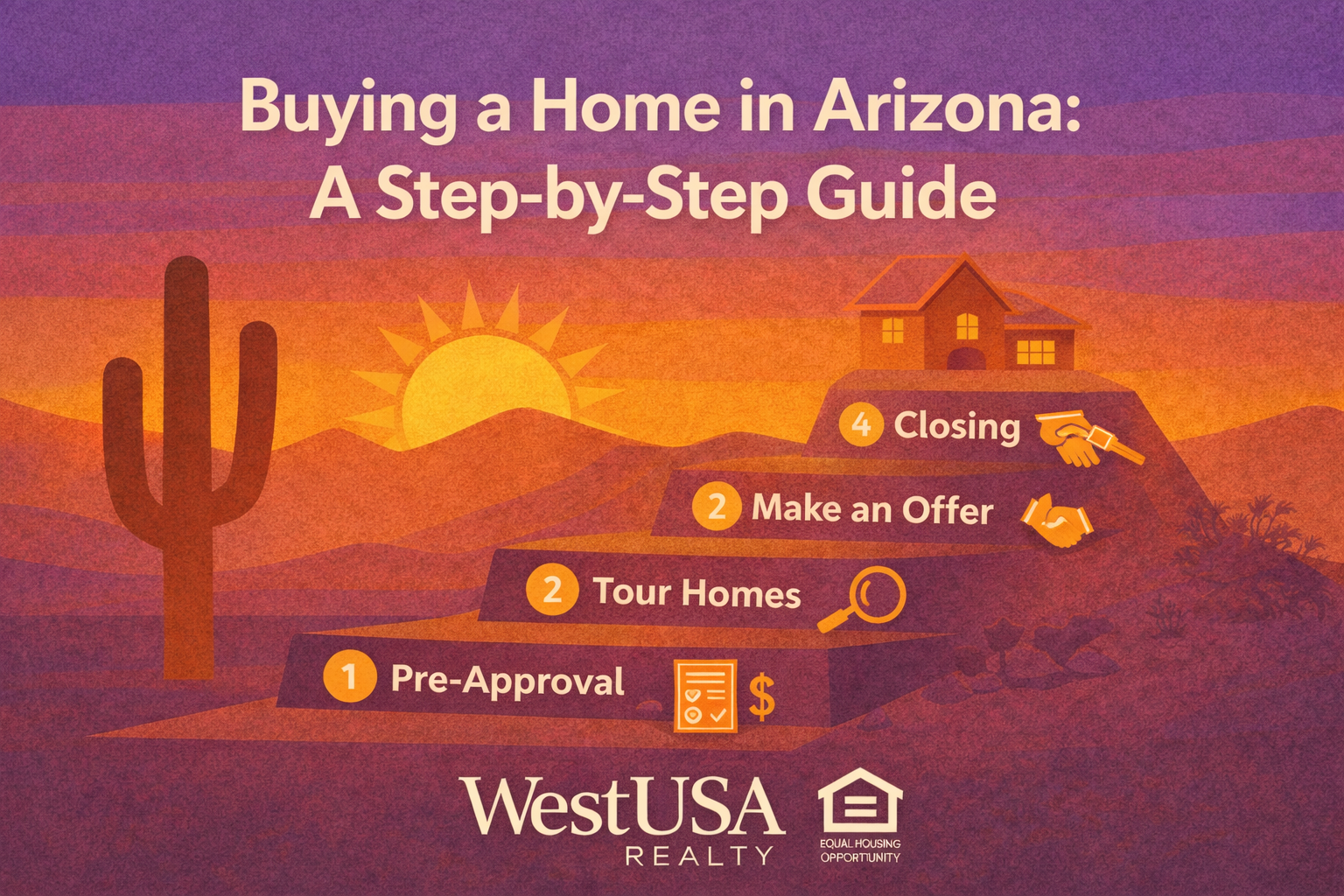
(So You Don’t Panic, Overthink, or Google at 2 a.m.)**
Buying a home in Arizona can feel a little like hiking Camelback Mountain for the first time.
You’re excited.
You’re slightly nervous.
And at some point you think, “Wait… did I prepare enough for this?”
Good news: the Arizona home buying process is actually very straightforward — especially when you know what to expect and have the right guide.
Let’s walk through how buying a home in Arizona works, step by step, in plain English. No jargon. No pressure. No mystery.
Most buyers don’t wake up one day magically “ready.”
They start with:
“I’m just looking…”
“We’re thinking about moving to Arizona.”
“Rent is getting ridiculous.”
“Is now a good time to buy in the Phoenix area?”
All of those count.
Whether you’re relocating to Avondale, upsizing in Goodyear, or moving somewhere in the Phoenix metro, the process starts with a conversation — not a commitment.
Before shopping seriously, you’ll want a mortgage pre-approval.
This tells you:
What price range makes sense
What your estimated payment looks like
How strong your offer will be
Think of it like this:
House shopping without a pre-approval is like going car shopping without knowing your budget. You can do it… but it gets awkward fast.
Bonus: In Arizona’s competitive market, sellers take pre-approved buyers much more seriously.
In Arizona, buyers now sign a Buyer Broker Agreement before touring homes. This simply confirms that your agent works for you — not the seller.
What your buyer’s agent does:
Finds homes that match your goals
Explains neighborhoods (especially important for relocators)
Negotiates price, repairs, and concessions
Keeps you from accidentally agreeing to something wild
Translation: You don’t have to do this alone.
Now the fun begins.
In the West Valley, buyers love:
Newer homes
Master-planned communities
Easy freeway access
Space (inside and out)
You’ll tour homes, compare neighborhoods, and slowly realize:
“Okay… I can actually picture my life here.”
And when the right home shows up — you’ll know.
Once you find “the one,” your agent helps you:
Decide on price
Request seller concessions
Set timelines that protect you
In Arizona, offers are typically submitted electronically and can move quickly — especially in popular areas like the West Valley and Phoenix suburbs.
This is where having a strong local agent really pays off.
Once your offer is accepted:
Inspections are scheduled
The lender orders an appraisal
Escrow officially opens
This phase is less glamorous, but incredibly important.
Good news: you’re not expected to understand everything on day one. We explain what matters, what’s normal, and what’s negotiable.
After final loan approval, signing and recording on the county records:
🎉 You get the keys
🎉 You officially own a home in Arizona
🎉 You immediately start thinking about furniture
From accepted offer to closing, most Arizona transactions take about 30 days — sometimes less.
Yes. Arizona uses escrow and has timelines and contracts that are unique to the state.
Nope. Many buyers use 3–5% down programs.
Yes — especially for buyers looking for value, space, and growth.
Absolutely. Many of our clients relocate from other states.
Buying a home doesn’t have to feel overwhelming.
You don’t need:
Perfect credit
A massive down payment
All the answers upfront
You just need:
✔ Good information
✔ A clear plan
✔ A team that explains things like humans
We believe buying a home should feel empowering, not intimidating.
Whether you’re a first-time buyer, relocating to Arizona, or just exploring your options in the Phoenix metro, we’re here to guide you step by step — with honesty, humor, and zero pressure.
📍 Rosie & Mariela Armenta
🏡 West USA Realty
📞 623-295-5770 or 623-396-7761
✉️ rosie@rosiearmenta.com
🏠 Equal Housing Opportunity
(Y no — no es una trampa, ni un matrimonio contractual, ni una estafa)
Si estás buscando casa en Arizona en este momento y un Realtor te dice:
“Antes de ver casas, necesitaremos firmar un Acuerdo de Representación del Comprador…”
Puede que inmediatamente pienses:
“¿Estoy firmando mi vida?”
“¿Esto es nuevo?”
“¿Por qué ahora todo lleva papeleo?”
“¿Todavía puedo ‘solo mirar’?”
Respira profundo. Agarra un cafecito. Aquí estamos para ayudarte ☕
Vamos a explicarte qué es el nuevo Acuerdo de Representación del Comprador, por qué existe y por qué en realidad TE protege a ti como comprador, especialmente en el área metropolitana de Phoenix y el West Valley.
Es un acuerdo por escrito que establece oficialmente que:
👉 Un agente de bienes raíces te representa a TI, el comprador.
👉 Te debe lealtad, confidencialidad y total transparencia.
👉 Está legalmente obligado a actuar en tu mejor interés — no en el del vendedor.
Piénsalo así:
No esperarías que un abogado o un contador trabajara gratis o sin claridad… bienes raíces no es diferente.
Este acuerdo deja claro para quién trabaja tu agente — y ese eres tú.
Excelente pregunta — y no, los Realtors no se levantaron un día queriendo complicar las cosas por diversión.
Debido a cambios a nivel de la industria y acuerdos legales, ahora los compradores deben firmar un acuerdo antes de que un agente pueda mostrar propiedades.
¿Por qué?
Porque la transparencia importa.
Esto protege a:
✔ Compradores
✔ Agentes
✔ Toda la transacción
Y elimina la confusión sobre quién representa a quién.
MITO:
“Si firmo esto, me quedo atrapado para siempre y no puedo hablar con ningún otro agente.”
REALIDAD:
Esto no es un tatuaje.
No es un matrimonio.
No es un contrato “de por vida”.
Los Acuerdos de Representación pueden ser:
De corto plazo
Específicos por área
Específicos por propiedad
Cancelables con comunicación
Te explicamos todo antes de que firmes.
Sin sorpresas. Sin momentos incómodos.
En mercados rápidos como Avondale, Goodyear y todo el West Valley, los compradores necesitan una representación fuerte.
¿Por qué?
Las casas se venden rápido
Las negociaciones importan
Los contratos de los constructores no favorecen al comprador
Los compradores que se mudan desde otro estado necesitan guía local
El acuerdo asegura que tu agente:
✔ Negocie por TI
✔ Te asesore a TI
✔ Proteja TUS intereses
Cuando firmas un Acuerdo de Representación, obtienes:
💬 Asesoría confidencial (tu presupuesto se mantiene privado)
💰 Negociación experta en precio y concesiones
🧠 Información del mercado que no puedes simplemente “googlear”
🏠 Guía en inspecciones, avalúos y contratos
📍 Experiencia local en el área metropolitana de Phoenix
Traducción: No estás comprando solo.
¿Es obligatorio el Acuerdo de Representación en Arizona?
Sí — antes de que un Realtor pueda mostrar casas, se requiere un acuerdo.
¿Firmar significa que yo pago directamente a mi agente?
No necesariamente. La compensación se explica claramente desde el inicio y muchas veces viene incluida en la transacción.
¿Los compradores primerizos pueden firmarlo?
Claro que sí — y deberían hacerlo. Son quienes más se benefician de la representación.
¿Y si me estoy mudando desde otro estado?
Con más razón. Necesitas protección y guía local.
¿Se puede cancelar?
Los acuerdos varían — pero la flexibilidad y la claridad siempre se explican primero.
Comprar una casa sin representación es como:
Ir a la corte sin abogado
Jugar Monopoly sin saber las reglas
Dejar que el agente del vendedor te “ayude” (spoiler: trabaja para el vendedor)
El Acuerdo de Representación asegura que alguien esté de tu lado.
No creemos en la presión.
No creemos en papeleo confuso.
Creemos en educación, transparencia y confianza.
El Acuerdo de Representación no es para atraparte — es para respaldarte como comprador.
Si tienes preguntas, te explicamos todo en español claro y sencillo — sin diccionario legal incluido.
📍 Rosie & Mariela Armenta
🏡 West USA Realty
📞 623-295-5770 o 623-396-7761
✉️ rosie@rosiearmenta.com
🏠 Equal Housing Opportunity
(And No — It’s Not a Trap, a Contract Marriage, or a Scam)**
If you’re house-hunting in Arizona right now and a Realtor says,
“Before we tour homes, we’ll need a Buyer Broker Agreement…”
You might immediately think:
“Am I signing my life away?”
“Is this new?”
“Why does everyone suddenly need paperwork?”
“Can I still ‘just look’?”
Take a deep breath. Grab a cafecito. We’ve got you ☕
Let’s break down what the new Buyer Broker Agreement is, why it exists, and why it actually protects YOU as a buyer — especially in the Phoenix metro and West Valley.
A Buyer Broker Agreement is a written agreement that officially states:
👉 A real estate agent is representing YOU, the buyer.
👉 They owe you loyalty, confidentiality, and full transparency.
👉 They are legally working in your best interest — not the seller’s.
Think of it like this:
You wouldn’t expect a lawyer or accountant to work for free or without clarity… real estate is no different.
This agreement makes it clear who your agent is working for — and that agent is you.
Great question — and no, Realtors didn’t wake up one day and decide to make things complicated for fun.
Due to industry-wide changes and legal settlements, buyers must now sign an agreement before an agent can show homes.
Why?
Because transparency matters.
This protects:
✔ Buyers
✔ Agents
✔ The entire transaction
And it eliminates confusion around who represents whom.
MYTH:
“If I sign this, I’m stuck forever and can’t talk to any other agent.”
REALITY:
This is not a tattoo.
This is not a marriage.
This is not “locked in for life.”
Buyer Broker Agreements can be:
Short-term
Area-specific
Property-specific
Cancelable with communication
We explain everything before you sign. No surprises. No awkwardness.
In fast-moving markets like Avondale, Goodyear, and across the West Valley, buyers need strong representation.
Here’s why:
Homes move quickly
Negotiations matter
Builder contracts are not buyer-friendly
Relocating buyers need local guidance
The agreement ensures your agent:
✔ Negotiates for YOU
✔ Advises YOU
✔ Protects YOUR interests
When you sign a Buyer Broker Agreement, you get:
💬 Confidential advice (your budget stays private)
💰 Skilled negotiation on price and concessions
🧠 Market insight you can’t Google
🏠 Guidance on inspections, appraisals, and contracts
📍 Local expertise in the Phoenix metro
Translation: You’re not shopping alone.
Yes — before a Realtor can show homes, an agreement is required.
Not necessarily. Compensation is explained clearly upfront and often comes from the transaction itself.
Absolutely — and they should. First-time buyers benefit the most from representation.
Even more reason to sign one. You need local protection and guidance.
Agreements vary — but flexibility and clarity are always discussed first.
Trying to buy a home without representation is like:
Going to court without a lawyer
Playing Monopoly without knowing the rules
Letting the seller’s agent “help” you (spoiler: they work for the seller)
The Buyer Broker Agreement makes sure someone is on your side.
We don’t believe in pressure.
We don’t believe in confusing paperwork.
We believe in education, transparency, and trust.
The Buyer Broker Agreement isn’t about locking you in — it’s about showing up for you as buyers.
If you have questions, we explain everything in plain English — no legal dictionary required.
📍 Rosie & Mariela Armenta
🏡 West USA Realty
📞 623-295-5770 or 623-396-7761
✉️ rosie@rosiearmenta.com
🏠 Equal Housing Opportunity
.png)
 (Sí, Aquí Puedes Hacer Crecer Tu Negocio y Tener Vida)**